From Hunting Tradition to Sustainable Conservation in Eswatini

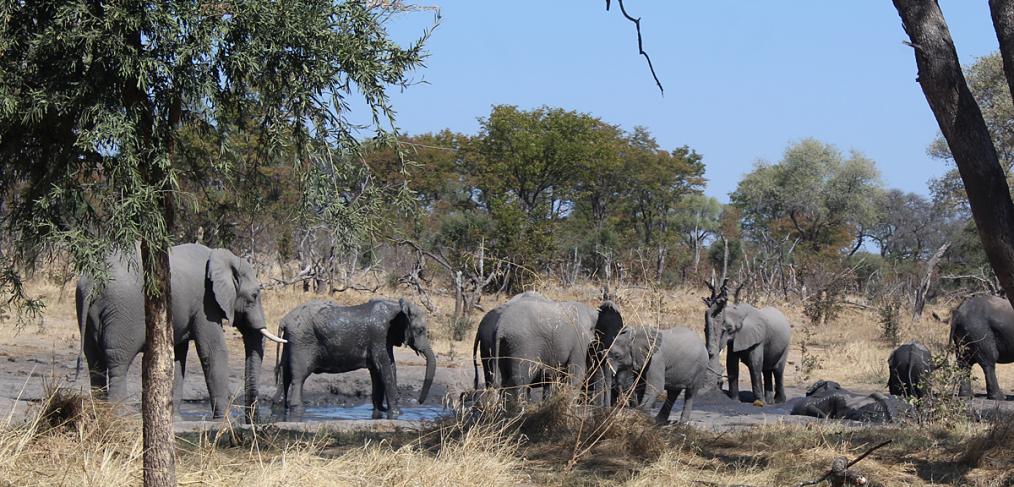
The lion, symbol of our King (Ingwenyama), and the matriarch elephant, symbol of our Queen Mother (iNdlovukazi), both appear on the Eswatini national crest. During the colonial period, both species became locally extinct.

It was unthinkable that neither of these important animals was present in the then Swaziland at the time of independence from the British Empire. Their absence provided an additional reason for restoring both species to Swaziland. The elephant returned in 1986 and the lion in 1994, both from Kruger National Park. Hlane Royal National Park is now home to both lion and elephant, although it is too small to support free-roaming populations of these species.

Butimba: The Royal hunt and its significance

Hlane Royal National Park plays an important role in the cultural heritage of the Kingdom of Eswatini. It provides an overflow of animals from the core conservation area of the park into an adjoining dispersal
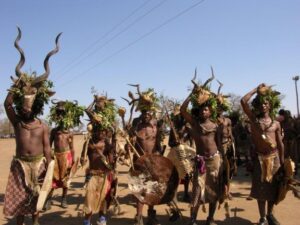
Different species of game carried by regiments

buffer zone, which is the traditional Royal hunting ground of the nation. It is in this area that the Butimba, the Royal Hunt, is occasionally called by the King, and every liSwati (the demonym used to describe a person from Eswatini) is welcome to participate.

Butimba literally refers to a hunting expedition. Conservation literature on Swati culture describes the Royal Hunt as a tradition that has been practiced for centuries, during which the King and his regiments hunted game for the royal household and the nation. The Butimba also provides game meat, skins and other materials used in traditional ceremonies and attire.

By 1966, however, wildlife populations had become so depleted that the traditional hunt had lost much of its practical purpose. This created a fundamental challenge: how could a hunting tradition be maintained when there was almost nothing left to hunt?

Conservation intervention

Published conservation history records that King Sobhuza II (1921-1982) recognized the cultural importance of the Royal Hunt and ordered the protection of the Hlane area, with Ted Reilly entrusted with its stewardship. The underlying principle was essentially to protect the breeding stock so that there would be a surplus in the future. This philosophy transformed the relationship between Butimba and wildlife.

The protection of Hlane allowed wildlife populations to recover. Today, Hlane is Eswatini’s largest protected area, and Big Game Parks manages it on behalf of the King and the nation. The park contains elephants, rhinoceroses, lions, leopards and numerous other wild species. Butimba survived because the wildlife survived. Wildlife conservation therefore became a means of conserving the cultural institution itself.

Interdependence of culture and nature
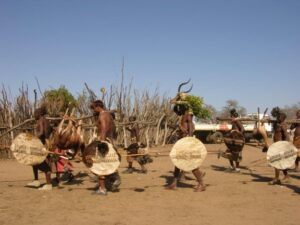
Regiments return with game from hunting assignment.

The modern Butimba is therefore based on the principle that there must be a healthy wildlife population from which a controlled harvest can be made without destroying the population.

The King has traditionally been associated with the welfare of the Kingdom and its people. Consequently, the Royal Hunt places the King and the traditional age regiment, known as Libutfo, directly within the landscape from which food and other natural resources are obtained. This is significant because Swati culture has historically been closely connected to the natural environment. Eswatini’s biodiversity strategy specifically identifies Butimba as an example of the country’s socio-cultural relationship with biodiversity. The biodiversity strategy makes an important observation: if the antelope species in the hunting area were exterminated, Butimba itself would eventually disappear. In other words, the survival of the cultural practice depends on the survival of the ecosystem.

Kushisa tikhotsa: Managing the habitat

“Kushisa tikhotsa” otherwise known as controlled burning, is an important part of the ceremony. Its purpose is to remove old vegetation under controlled conditions so that new vegetation can grow and provide nutritious grazing for wildlife. Today’s ceremony can therefore be understood as having two closely connected dimensions: “Kushisa tikhotsa”, which involves managing the habitat, and controlled hunting, which involves managing the wildlife population. Together, these practices are intended to support a sustainable ecosystem. Modern Butimba can consequently be understood as a ceremony involving wildlife, environmental conservation, and the relationship between people and nature, rather than hunting alone.

Conclusion: Preserving Butimba through conservation

There is a fascinating paradox at the heart of Butimba’s history: hunting nearly destroyed the wildlife resource on which the hunt depended. As game numbers declined, Butimba lost much of its practical foundation. The response was not necessarily to abandon the tradition permanently. Instead, conservation created the conditions under which the tradition could survive and develop a new ecological dimension.

The history of Butimba therefore demonstrates a close relationship between culture and conservation. The survival of the Royal Hunt depends on the survival of wildlife and its habitat, while the continuation of the tradition provides a cultural reason to value and protect that natural heritage.
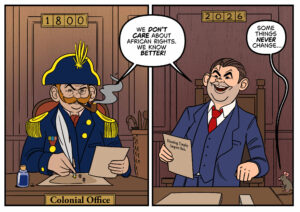

7 Reasons a UK Trophy Hunting Import Ban Is a Bad Idea

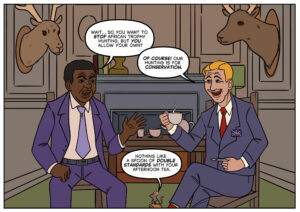
The proposed UK trophy hunting import ban, though framed as a compassionate morality play, risks doing far more harm than good by substituting Western emotion for African evidence. Across Southern Africa, wildlife is not an abstract ideal but a lived reality requiring active management. Implementing a blanket import ban exposes a deep-seated ‘white savior’ complex and neocolonial undertones in London-based policymaking, where critical decisions are made without consulting those most affected.

When international policies strip away the economic value of wildlife, they do not preserve it. Instead, they dismantle the funding that drives successful conservation and supports rural economies. This high-stakes legislative move threatens the livelihoods of millions of rural Africans, abandoning local communities to bear the heavy costs of conservation entirely alone. Ultimately, understanding these complex dynamics highlights the 7 Reasons a UK Trophy Hunting Import Ban Is a Bad Idea:

  1. It targets the wrong problem

For the species affected, trophy hunting is not the main threat. Habitat loss, land conversion, poaching, and retaliation linked to human-wildlife conflict are far bigger risks — and that is where the focus needs to be.

  1. It could hurt the wildlife it aims to protect

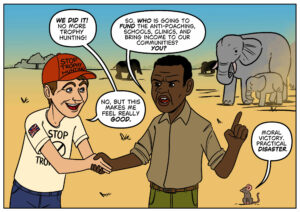
Regulated hunting helps pay for rangers, anti-poaching work, roads, monitoring, and wildlife management. Remove that income, and protection systems weaken. In practice, a ban could do the opposite of what it intends: less funding can mean fewer patrols, more poaching, poorer habitat management, and ultimately less wildlife.

  1. It hurts rural communities

Hunting revenue also supports jobs, household income, and community services such as schools and clinics in remote areas where tourism is often not feasible, and few other economic opportunities exist and removing that income would have devastating impacts on many rural communities.

  1. It can reduce tolerance for dangerous wildlife

Living with elephants, lions, crocodiles, and other wildlife can carry real costs. When benefits disappear but risks remain, support for wildlife can fall, and communities may retaliate against animals that raid crops or kill livestock.

  1. It can lead to land-use change

If people living alongside wildlife are only bearing the costs of coexistence, and see no benefits in return, there is a real risk that animals will be removed, and land converted to farming, livestock, or other uses. That can mean less space for nature.

  1. It ignores African voices

This debate is not happening in a vacuum. Decisions made in London affect people and wildlife thousands of miles away. The communities and governments most affected should be consulted, not treated as an afterthought.

  1. The UK already has strict controls

The UK does not allow trophy imports without checks. In practice, trophies can only be imported where they are legally sourced and where the hunt has demonstrated proven conservation value. A blanket ban would sweep away that targeted approach, and with it the conservation value that the current system can support.

The better question

This debate should not be about what sounds good in Britain. It should be about what works in practice for wildlife, what is fair to people who live with wildlife every day, and what is supported by peer-reviewed evidence?

References:

  • Challender, D. W. S., Cooney, R., Biggs, D., Dickman, A., Milner-Gulland, E. J., Redford, K. H., & Roe, D. (2024). Evaluating key evidence and formulating regulatory alternatives regarding the UK’s Hunting Trophies (Import Prohibition) Bill. Conservation Science and Practice, 6(10), e13220. https://doi.org/10.1111/csp2.13220
  • Commission Regulation (EC) No 865/2006 of 4 May 2006 laying down detailed rules concerning the implementation of Council Regulation (EC) No 338/97. Retained in UK law post-Brexit. https://www.legislation.gov.uk/eur/2006/865
  • Cooney, R., Freese, C., Dublin, H., Roe, D., Mallon, D., Knight, M., Emslie, R., Pani, M., Booth, V., Mahoney, S., & Buyanaa, C. (2017). The baby and the bathwater: Trophy hunting, conservation and rural livelihoods. Unasylva, 68(249), 3–16. Food and Agriculture Organization of the United Nations (FAO). https://www.fao.org/3/i7337en/i7337en.pdf
  • Council Regulation (EC) No 338/97 of 9 December 1996 on the protection of species of wild fauna and flora by regulating trade therein. Retained in UK law post-Brexit.
  • Department for Environment, Food & Rural Affairs (DEFRA). (2021). Ban on the import of hunting trophies: Impact assessment. https://publications.parliament.uk/pa/bills/cbill/58-03/0026/HuntingTrophies(ImportProhibition)BillImpactAssessment.pdf
  • Intergovernmental Science-Policy Platform on Biodiversity and Ecosystem Services (IPBES). (2019). Summary for policymakers of the global assessment report on biodiversity and ecosystem services. IPBES Secretariat. https://ipbes.net/globalassessment
  • IUCN Sustainable Use and Livelihoods Specialist Group (SULi), CEESP, & SSC. (2016, updated 2023). Informing decisions on trophy hunting: A briefing paper regarding issues to be taken into account when considering restriction of imports of hunting trophies. IUCN.
  • Jaureguiberry, P., Titeux, N., Wiemers, M., Bowler, D. E., Coscieme, L., Golden, A. S., Jacob, U., Takahashi, Y., Settele, J., & Díaz, S. (2022). The direct drivers of recent global anthropogenic biodiversity loss. Science Advances, 8(45), eabm9982. https://doi.org/10.1126/sciadv.abm9982
  • Lindsey, P. A., Roulet, P. A., & Romanach, S. S. (2007). Economic and conservation significance of the trophy hunting industry in sub-Saharan Africa. Biological Conservation, 134(4), 455–469. https://doi.org/10.1016/j.biocon.2006.09.005
  • (2022, February 14). Conflicting attitudes around the trophy hunting ban. https://www.survation.com/conflicting-attitudes-around-the-trophy-hunting-ban
  • Vorhies, F. (2024). Elephant in the Room: Why a Trophy Hunting Ban Would Hurt Conservation and Development. African Wildlife Economy Institute & Institute of Economic Affairs. https://iea.org.uk/publications/elephant-in-the-room/

CLN to Participate in the AICA General Assembly 2026

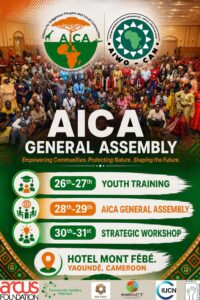
We are proud to participate in the AICA General Assembly 2026, taking place from 28–29 May 2026. The Assembly, convened by the Alliance for Indigenous Peoples and Local Communities for Conservation in Africa (AICA), brings together Indigenous Peoples and Local Communities (IPLCs), conservation leaders, and partners from across Africa.

For Southern Africa, conservation is more than protecting nature – it is about protecting land rights, culture, livelihoods, and community knowledge systems. Indigenous communities continue to play a vital role in safeguarding biodiversity and promoting sustainable environmental practices.

As a proud partner of AICA, CLN values this important platform for collaboration, advocacy, and regional solidarity. The Assembly presents an opportunity to amplify Southern African voices and strengthen community-led conservation approaches that place people, nature, and justice at the centre of sustainable development.

CLN looks forward to engaging with partners across Africa to advance inclusive conservation and Indigenous rights for present and future generations.