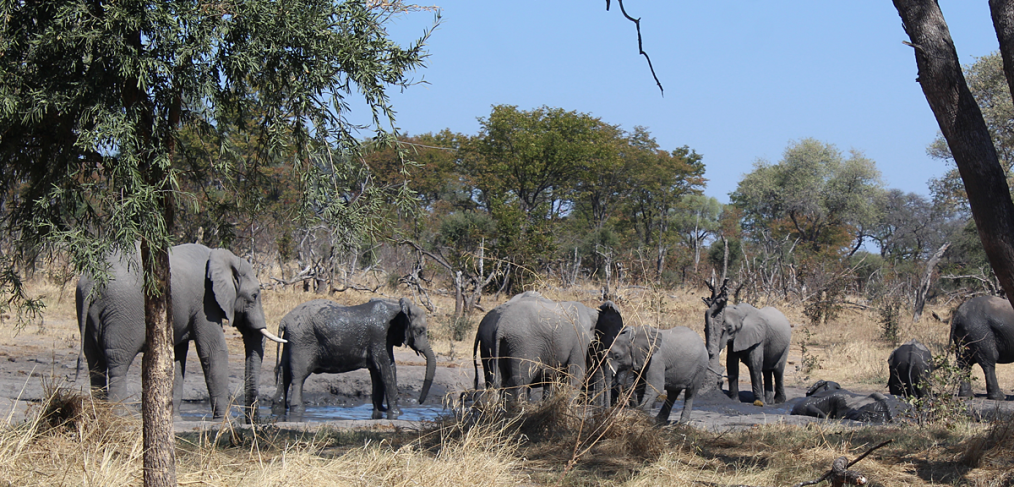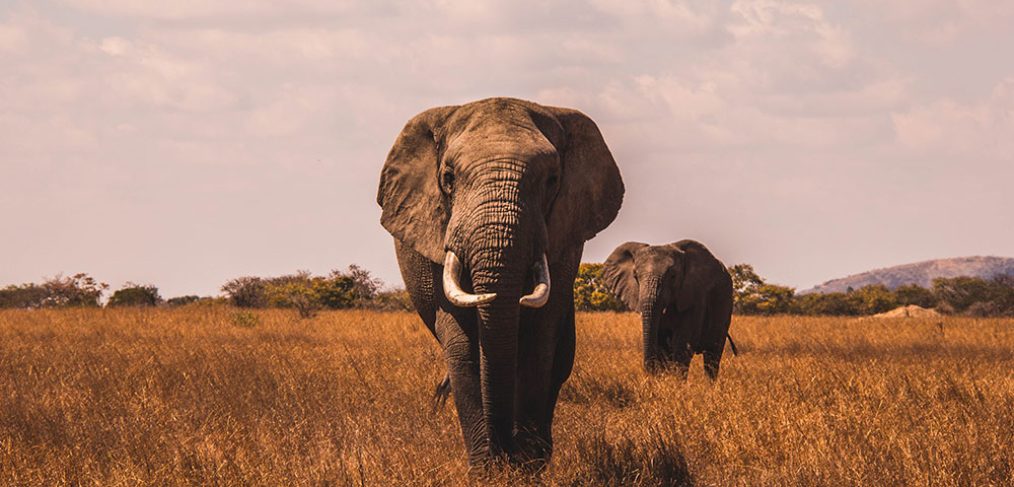
The lion, symbol of our King (Ingwenyama), and the matriarch elephant, symbol of our Queen Mother (iNdlovukazi), both appear on the Eswatini national crest. During the colonial period, both species became locally extinct.
It was unthinkable that neither of these important animals was present in the then Swaziland at the time of independence from the British Empire. Their absence provided an additional reason for restoring both species to Swaziland. The elephant returned in 1986 and the lion in 1994, both from Kruger National Park. Hlane Royal National Park is now home to both lion and elephant, although it is too small to support free-roaming populations of these species.
Butimba: The Royal hunt and its significance
Hlane Royal National Park plays an important role in the cultural heritage of the Kingdom of Eswatini. It provides an overflow of animals from the core conservation area of the park into an adjoining dispersal
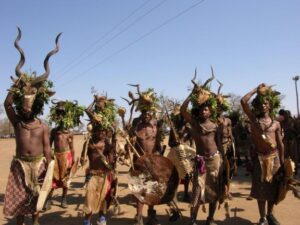
Different species of game carried by regiments
buffer zone, which is the traditional Royal hunting ground of the nation. It is in this area that the Butimba, the Royal Hunt, is occasionally called by the King, and every liSwati (the demonym used to describe a person from Eswatini) is welcome to participate.
Butimba literally refers to a hunting expedition. Conservation literature on Swati culture describes the Royal Hunt as a tradition that has been practiced for centuries, during which the King and his regiments hunted game for the royal household and the nation. The Butimba also provides game meat, skins and other materials used in traditional ceremonies and attire.
By 1966, however, wildlife populations had become so depleted that the traditional hunt had lost much of its practical purpose. This created a fundamental challenge: how could a hunting tradition be maintained when there was almost nothing left to hunt?
Conservation intervention
Published conservation history records that King Sobhuza II (1921-1982) recognized the cultural importance of the Royal Hunt and ordered the protection of the Hlane area, with Ted Reilly entrusted with its stewardship. The underlying principle was essentially to protect the breeding stock so that there would be a surplus in the future. This philosophy transformed the relationship between Butimba and wildlife.
The protection of Hlane allowed wildlife populations to recover. Today, Hlane is Eswatini’s largest protected area, and Big Game Parks manages it on behalf of the King and the nation. The park contains elephants, rhinoceroses, lions, leopards and numerous other wild species. Butimba survived because the wildlife survived. Wildlife conservation therefore became a means of conserving the cultural institution itself.
Interdependence of culture and nature
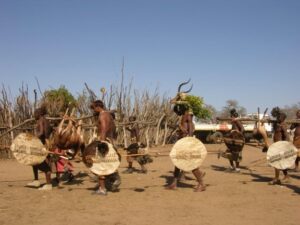
Regiments return with game from hunting assignment.
The modern Butimba is therefore based on the principle that there must be a healthy wildlife population from which a controlled harvest can be made without destroying the population.
The King has traditionally been associated with the welfare of the Kingdom and its people. Consequently, the Royal Hunt places the King and the traditional age regiment, known as Libutfo, directly within the landscape from which food and other natural resources are obtained. This is significant because Swati culture has historically been closely connected to the natural environment. Eswatini’s biodiversity strategy specifically identifies Butimba as an example of the country’s socio-cultural relationship with biodiversity. The biodiversity strategy makes an important observation: if the antelope species in the hunting area were exterminated, Butimba itself would eventually disappear. In other words, the survival of the cultural practice depends on the survival of the ecosystem.
Kushisa tikhotsa: Managing the habitat
“Kushisa tikhotsa” otherwise known as controlled burning, is an important part of the ceremony. Its purpose is to remove old vegetation under controlled conditions so that new vegetation can grow and provide nutritious grazing for wildlife. Today’s ceremony can therefore be understood as having two closely connected dimensions: “Kushisa tikhotsa”, which involves managing the habitat, and controlled hunting, which involves managing the wildlife population. Together, these practices are intended to support a sustainable ecosystem. Modern Butimba can consequently be understood as a ceremony involving wildlife, environmental conservation, and the relationship between people and nature, rather than hunting alone.
Conclusion: Preserving Butimba through conservation
There is a fascinating paradox at the heart of Butimba’s history: hunting nearly destroyed the wildlife resource on which the hunt depended. As game numbers declined, Butimba lost much of its practical foundation. The response was not necessarily to abandon the tradition permanently. Instead, conservation created the conditions under which the tradition could survive and develop a new ecological dimension.
The history of Butimba therefore demonstrates a close relationship between culture and conservation. The survival of the Royal Hunt depends on the survival of wildlife and its habitat, while the continuation of the tradition provides a cultural reason to value and protect that natural heritage.