Adaptation for the Mountain Kingdom of Lesotho is best centered around climate resilience for improved agriculture productivity that provides food security for the Basotho Nation. One of Lesotho’s greatest agricultural assets is its biological diversity. Traditional crop varieties, livestock breeds and locally adapted farming knowledge represent resources that have developed under the country’s particular environmental conditions. Over the years, climate change has created pressure to find crops and agricultural systems capable of tolerating new environmental conditions. Therefore, it has become essential to explore introduction of new biological technologies while taking appropriate safeguards (bio-safety) to prevent ecological risks, including effects on biodiversity.
For Lesotho, climate resilience is particularly relevant because agricultural production is affected by drought, changing rainfall patterns, land degradation, pests, soil constraints and other climate-related stresses. Modern biotechnology offers potential tools for addressing some of these challenges, for example through crops with improved resistance to particular climate stresses. However, the role of biosafety is to ensure that food security objectives are pursued safely and responsibly. Before introduction, cultivation or importation of a LMO (Living Modified Organism) or GMO (Genetically Modified Organism); appropriate assessment is required to understand potential effects on human health, biodiversity, agricultural ecosystems and socio-economic conditions. Therefore, Lesotho’s objective should not simply be to adopt as much biotechnology as possible, nor should biosafety be treated as a reason to reject technological innovation automatically. Instead, the purpose of a strong biosafety system is to provide evidence-based procedures for determining which technologies are appropriate, under what conditions and with what safeguards.
The principle is particularly important for a country whose agricultural economy is already vulnerable to environmental change. The country is surrounded by mountains and heavily dependent on climate-sensitive agriculture, climate change is not simply an environmental concern for Lesotho. It is a question of food, livelihoods, water and national resilience. The Kingdom of Lesotho faces increasing pressure from droughts, irregular rainfall, intense rainfall events, land degradation and other forms of climate variability. These pressures are particularly significant because much of the country’s agriculture depends on rainfall.
In this environment, adaptation requires more than improving irrigation systems or changing farming practices. It also requires Lesotho to carefully manage the technologies that could help agriculture respond to a changing climate. This is where bio-safety becomes important.
Therefore, Lesotho regards biosafety in the environmental context as an essential system of policies, laws, institutions, procedures and scientific measures that can be pursued to ensure that modern biotechnology, including genetically modified organisms (LMOs /GMOs), is developed, handled, transported, used and released in a manner that prevents or minimizes risk to biodiversity, the environment and to human health. For Lesotho, this is particularly important because the country has fragile mountain ecosystems, limited agricultural land, high dependence on natural resources and agriculture, and vulnerability to environmental degradation and climate variability. Therefore, biosafety should not only focus on whether a GMO is safe in isolation, but also consider its potential effects on local ecosystems, indigenous species, agricultural systems and livelihoods.
According to Mr. Maboi Mahula, a Senior Environmental Officer in the Department of Environment, “biosafety in practical terms, means conducting risk assessment before environmental release, appropriate containment and management measures, monitoring of approved activities, public awareness and participation, and enforcement of biosafety requirements” He also assets that agriculture is one of the areas where modern biotechnology may potentially contribute to improving productivity and increasing food security by improving climate resilience”. He further indicated that Lesotho has made progress in developing policies, strategies and institutional frameworks addressing climate change adaptation, disaster risk reduction, environmental management and sustainable development. However, implementation capacity remains an important issue.
Climate change and food security in Lesotho
Agriculture remains closely connected to the livelihoods of Basotho. Lesotho’s first Nationally Determined Contribution noted that rain-fed agriculture is highly vulnerable to climate variability and that up to 80% of the population engages in some form of agriculture-related activity. The same document identified agriculture, water, forestry, health and other sectors as particularly vulnerable to climate change.
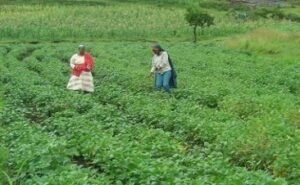
Source: Department of Agricultural Research
The vulnerability of agriculture is intensified by existing structural challenges. A World Bank assessment found that many farming households operate on small landholdings, while farmers also face limited access to irrigation, agricultural technologies, finance, infrastructure and technical services. Drought and intense rainfall contribute to soil erosion, declining soil quality and unstable agricultural production. This creates a difficult cycle. When rainfall is insufficient, crop yields can fall and households may have to rely more heavily on food purchases. When heavy rainfall occurs, erosion and flooding can damage agricultural land and infrastructure. Consequently, improving food security in Lesotho requires agricultural systems that can remain productive under increasingly variable conditions. Climate adaptation therefore has to consider not only how much food is produced, but also whether production systems can continue functioning when environmental conditions change.
Where biosafety enters the climate conversation
Biosafety is sometimes discussed mainly in relation to GMOs. However, in the context of climate adaptation, it can be understood more broadly as a governance mechanism that allows countries to evaluate biotechnology.
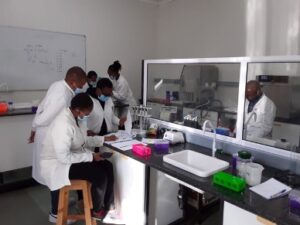
Source: National University of Lesotho Laboratory while managing its potential environmental and health risks.
Modern biotechnology may contribute to climate resilience through technologies designed to improve characteristics such as drought tolerance, resistance to pests and diseases, nutritional characteristics or agricultural productivity. These technologies do not automatically solve climate-related problems, and their suitability depends on local environmental, economic and social conditions. Nevertheless, they can form one component of a larger climate-smart agriculture strategy.
Lesotho’s own climate adaptation planning already recognizes the importance of technology and innovation. A 2024 Lesotho technology needs assessment for adaptation identifies climate-resilient agricultural technologies, including drought-tolerant crops, climate-resilient livestock breeds, precision agriculture and improved soil and water management. It also identifies research, technology transfer, capacity building and appropriate regulatory frameworks as important enabling conditions.
This is significant because technological innovation without appropriate governance can create new risks. Biosafety provides the institutional mechanism through which those risks can be assessed before technologies are introduced, released or used on a larger scale.
Lesotho’s biosafety framework
Lesotho is a Party to the Cartagena Protocol on Biosafety, an international agreement designed to address potential adverse effects of living modified organisms on biological diversity while also taking human health into account. Lesotho ratified the Protocol in September 2001.
The country also has a National Biosafety Policy dating from 2005, and the Department of Environment has undertaken projects aimed at strengthening institutional capacity for implementing biosafety and meeting obligations under the Cartagena Protocol. These efforts have included developing systems for applications, environmental monitoring, public awareness, participation and access to information.
However, translating policy into a fully functioning regulatory system has been a continuing challenge. The Biosafety Bill has gone through several stages of development. A 2022 version was tabled in the National Assembly and proposed establishing a National Biosafety Council and a Biosafety Tribunal, regulating GMOs and modern biotechnology, controlling their import and export, requiring permits for genetic modification activities and establishing risk-management and monitoring requirements. The parliamentary committee recommended that the Bill be passed with amendments.
More recently, the Biosafety Bill, 2025 appeared on the National Assembly’s legislative agenda for first reading in November 2025. Lesotho’s 2026 biodiversity reporting also identifies the Biosafety Bill 2025 and related biosafety initiatives as part of the country’s developing framework, while describing scientifically sound risk assessment of living modified organisms as still under development.
This legislative development matters for climate adaptation because biotechnology can only contribute responsibly to food security if there are credible systems for evaluating potential risks.
Biosafety and food security
Food security depends on more than the physical availability of food. It also depends on people’s ability to access food consistently and sustainably. Climate-resilient agriculture can contribute to food security by reducing the vulnerability of agricultural production to drought, pests, diseases and changing environmental conditions. Biotechnology may potentially contribute to these objectives, but it should be considered alongside conventional plant breeding, conservation agriculture, irrigation, soil restoration, improved extension services, crop diversification and indigenous knowledge.
The World Bank’s climate-smart agriculture assessment for Lesotho emphasizes precisely this broader approach. It describes climate-smart agriculture as an approach combining increased productivity, enhanced resilience and adaptation, and reduced emissions. Biosafety therefore should not be viewed as a standalone agricultural solution. Its role is to make technological innovation safer and more accountable within a wider food-security strategy.
For the Mountain Kingdom, biosafety represents an important intersection between environmental protection, agricultural development, scientific research and food security. A functioning biosafety framework could allow Lesotho to consider useful biotechnology while establishing procedures for identifying and managing potential risks to people, biodiversity and ecosystems.
The goal should therefore be neither unrestricted technological adoption nor technological avoidance. It should be responsible innovation: using scientific knowledge and biotechnology where appropriate, while maintaining strong systems for risk assessment, monitoring, transparency and public participation.